What is a Monte Carlo simulation? A plain-English guide
How playing a decision out a million times tells you how likely it is to work, and why a single forecast can't.
Why one forecast isn't enough
A normal forecast uses one number for each thing: next month's sales, this year's costs. But real life isn't one number. Sales go up and down, a quiet winter comes along, a big customer pays late. A plan can look fine on the average and still fail in a third of the ways the year could go. A single forecast can't show that. A simulation can.
Where the name comes from
The method was developed in the 1940s by the mathematicians Stanislaw Ulam and John von Neumann, and named after the Monte Carlo casino, because it runs on chance: you roll the dice on every uncertain number, many times over.
How it works, in four steps
- List what you know for sure. Rent, a salary, the cash in the bank today.
- List what you don't, as a range. Sales between X and Y, a 30% chance of a slow month.
- Play it out many times. Each run picks new values from the ranges and works the plan through.
- Count. In how many runs did it work? What did the failing runs have in common?
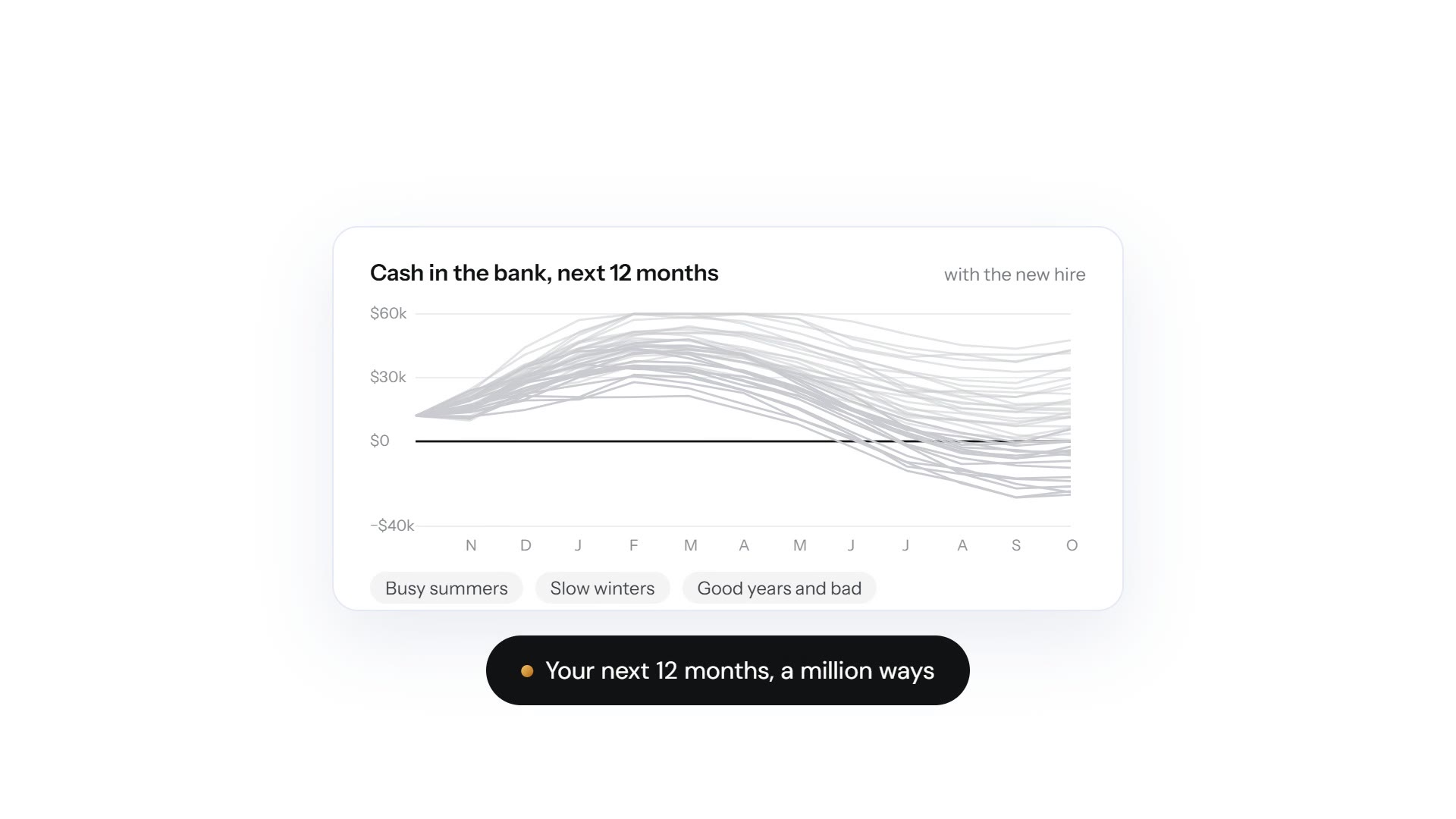
A worked example: can a café afford to hire?
An example café makes about $534,600 a year, busiest in summer. Its costs are $39,000 a month and it has $12,000 in the bank. It wants to hire someone on $65,000 a year, about $5,958 a month with employer costs.
The average says yes: the year ends with about $7,000 left. A Monte Carlo simulation plays out the next 12 months a million times, with each month's sales and the year as a whole a little better or worse each time, and checks whether the bank balance ever drops below zero:
| Hiring plan | Cash stays positive |
|---|---|
| Full time now | 610,101 of 1,000,000 (61%) |
| 4 days a week until September, then full time | 832,734 of 1,000,000 (83%) |
| 3 days a week until September, then full time | 949,625 of 1,000,000 (95%) |
Full time now runs out of cash in about 4 of 10 futures, mostly in late winter. Starting at 3 days a week is safe in 95 of 100. Same business, same hire, very different risk. These are real results from Gnomon, and you can run them yourself on the Gnomon page.
Why a million runs?
The more runs, the steadier the answer. With a million runs, a result like "61%" is accurate to about a tenth of a percentage point, so the number doesn't jump around when you run it again. Computers make this cheap: Gnomon runs a million in milliseconds.
What a simulation can't do
- It is only as good as its ranges. If sales could really fall 50%, a range that stops at 10% will look too safe.
- It shows odds, not promises. 95 in 100 is very good, and still not 100.
- It can't see what nobody listed. A new competitor or a fire isn't in the model unless you add it.
Using it without a spreadsheet
You don't need to build any of this. With Gnomon connected to Claude, ChatGPT or Grok, your AI sets up the simulation from your question and your numbers, runs it a million times through Gnomon, and gives you the answer with the odds.
Questions
What is a Monte Carlo simulation in simple terms?
A way to test a plan by playing it out many times with the uncertain numbers changed each time, then counting how often it works.
How many runs does a Monte Carlo simulation need?
Thousands give a rough answer. A million make the result steady, accurate to about a tenth of a percentage point for a share like 61%.
Is a Monte Carlo simulation accurate?
It is as accurate as the ranges you give it. Good ranges give a realistic picture of the odds; it never promises an outcome.
Can I run a Monte Carlo simulation in Excel?
Yes, with formulas and many rows, but it is slow to set up. Gnomon runs a million in milliseconds from inside your AI.
Let your AI check its work.
Add Gnomon to Claude, ChatGPT or Grok. Every answer that matters gets run a million times first.