How often is AI wrong? Why you should check its answers
AI answers fast and sounds sure, even when it is wrong. Why that happens, the mistakes that cost money, and how to check an answer before you act on it.
Why AI gets things wrong
Tools like Claude, ChatGPT and Grok are very good at writing. But they don't look facts up the way a person checks a record. They predict the most likely words for your question, based on what they learned and what you gave them. Most of the time that works. When it doesn't, the answer still reads well, so the mistake is easy to miss.
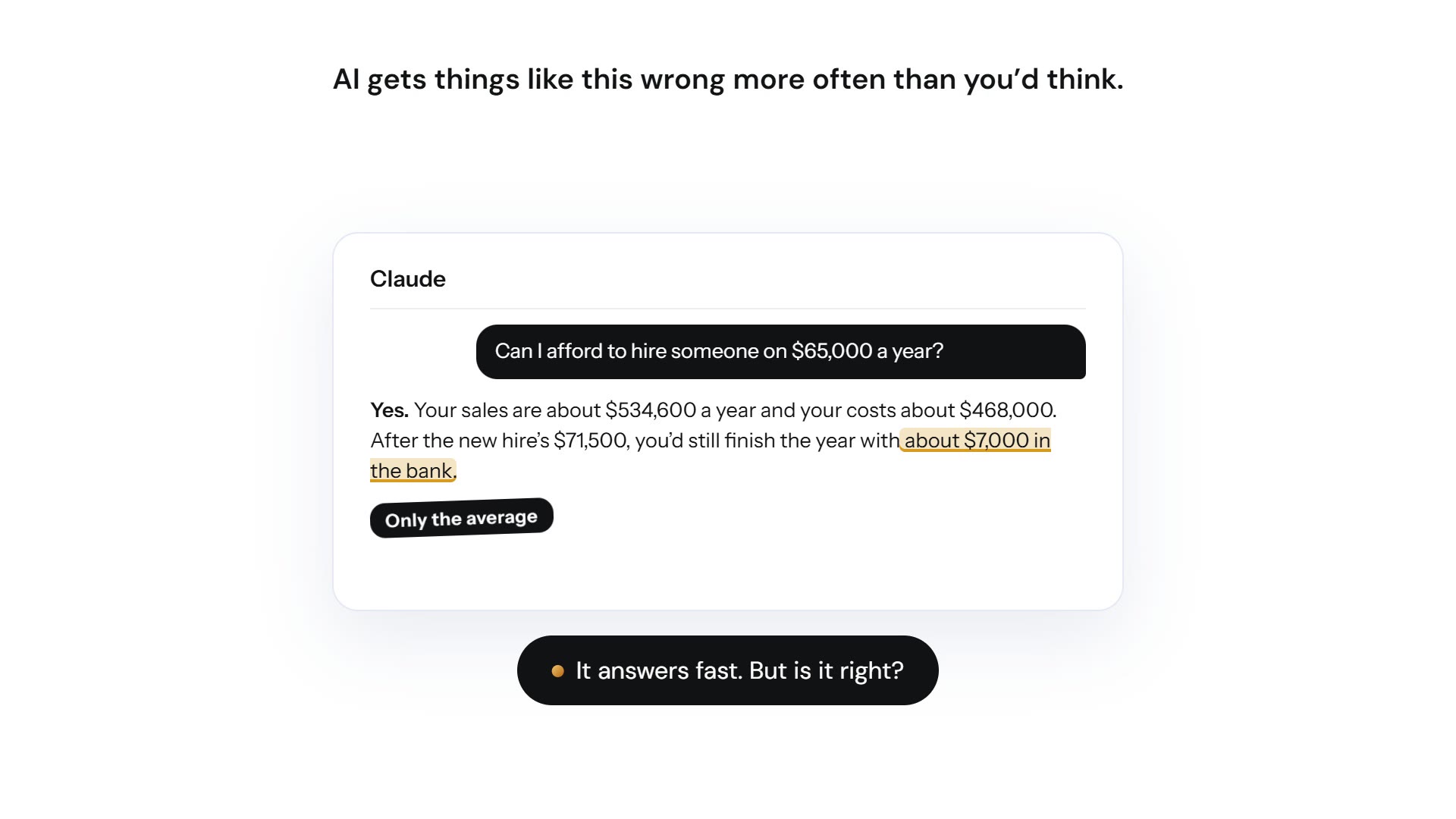
- They work from averages. Ask whether you can afford something and you get an answer based on a typical month, not your slow months.
- They don't know your records. Unless you paste them in, your price list, policies and bank balance are guesses.
- Their information can be old. Prices and rules change, and the AI may not know.
- They sound sure either way. There's no change in tone between a right answer and a wrong one.
The mistakes that cost a business money
A clumsy sentence costs nothing. These do:
- A wrong number: an old rate in a quote, a price that changed, a total that doesn't add up.
- A wrong promise: a refund policy or delivery date your business never offered. In 2024 a Canadian tribunal ordered Air Canada to compensate a customer after its website chatbot gave wrong information about a refund policy.
- A decision on the average: "yes, you can afford it" when you can, on average, but not in a slow winter.
- A dropped word: "do not" becoming "do", or "only" disappearing from a condition.
Can't you just ask the AI to double-check?
You can, and sometimes it catches its own slip. But it is the same AI checking the same work, with the same blind spots. It still doesn't have your records, it still works from averages, and it can give a different answer if you ask twice.
| Your AI checking itself | Your AI with Gnomon | |
|---|---|---|
| Who checks | The same AI that did the work | An independent checker, like an auditor |
| Your real prices and rules | Only if you paste them in each time | Checked exactly, to the cent |
| How sure it is | Sounds confident either way | A count from a million runs, with the steps shown |
| What could go wrong | A guess | The main risk, named |
| Same question twice | Can change its answer | Same result every time |
How to check an AI answer yourself
- Check every number against the source. Prices, rates, dates and totals: open the record, don't trust memory.
- Ask what it assumed. "What numbers did you use?" shows you where an average or an old rate slipped in.
- Ask for the bad case. "What happens in a slow month?" is often where the answer changes.
- Read the small words. Not, only, unless, at least, up to: one change flips the meaning.
- Decide how sure you need to be. A social post can be checked lightly. A quote, a payment or a hire can't.
Or let Gnomon check every time
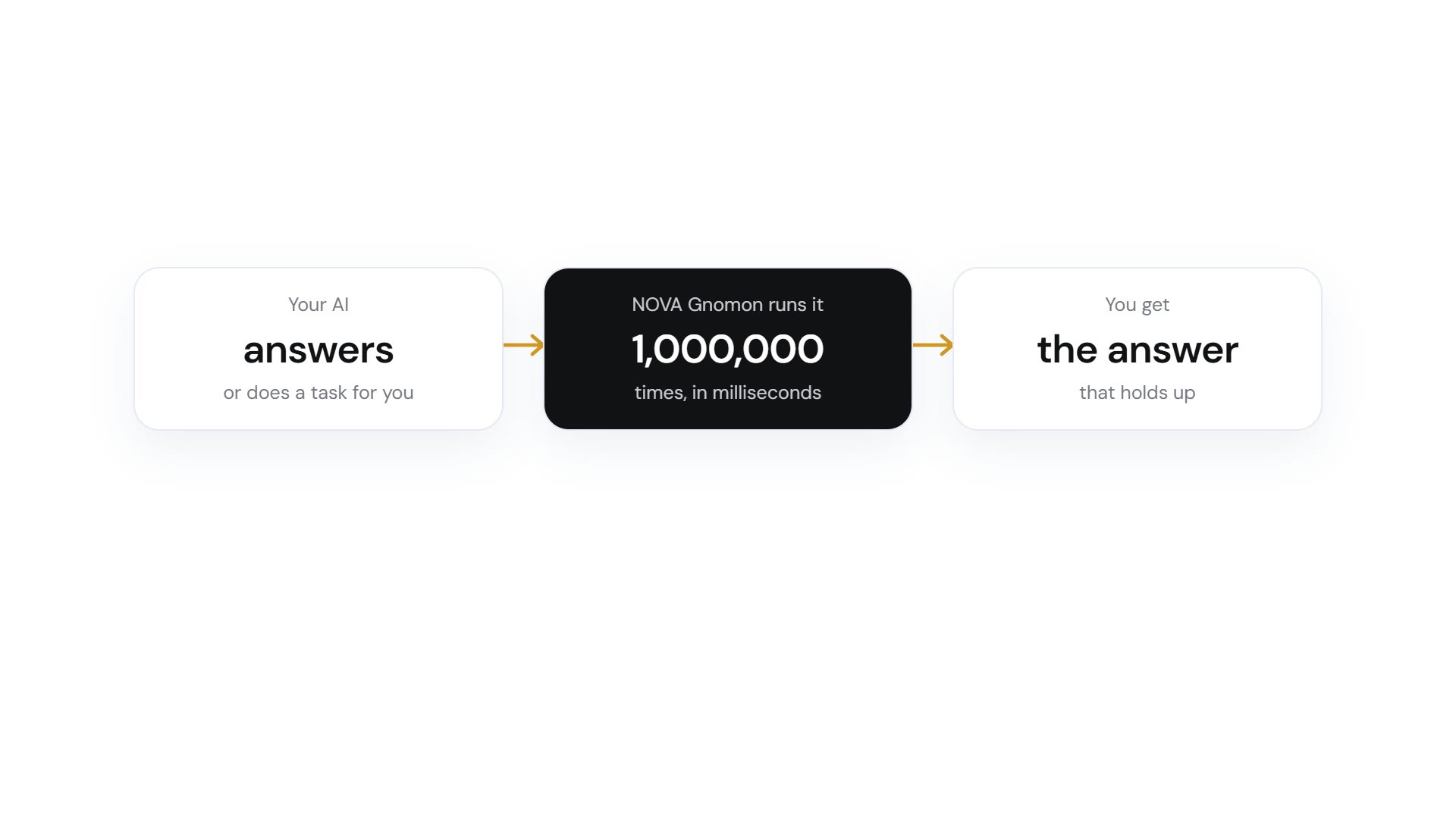
Gnomon plugs into the AI you already use. Whenever your AI gives you an answer or does a task for you, Gnomon checks the facts against your records and rules, and runs the decision a million times to see how often it works out. It takes milliseconds, and your AI comes back with an answer that holds up.
Read how the million runs work in what is a Monte Carlo simulation?, or see it on a real decision in can I afford to hire someone?
Questions
Is AI accurate?
Often, but not reliably enough to act on without checking when money, dates or promises are involved. AI writes the most likely answer, and it sounds just as confident when it is wrong.
Why does AI make things up?
It predicts likely words rather than looking facts up. When it doesn't have the real fact, it can fill the gap with something that sounds right.
Can I trust ChatGPT or Claude with business decisions?
Use them to draft and think, then check the numbers against your records before you act. Or connect Gnomon so answers are checked automatically.
Does asking the AI to double-check help?
Sometimes. But it is the same AI with the same blind spots, so it can repeat the mistake or change its answer if you ask again.
Let your AI check its work.
Add Gnomon to Claude, ChatGPT or Grok. Every answer that matters gets run a million times first.